
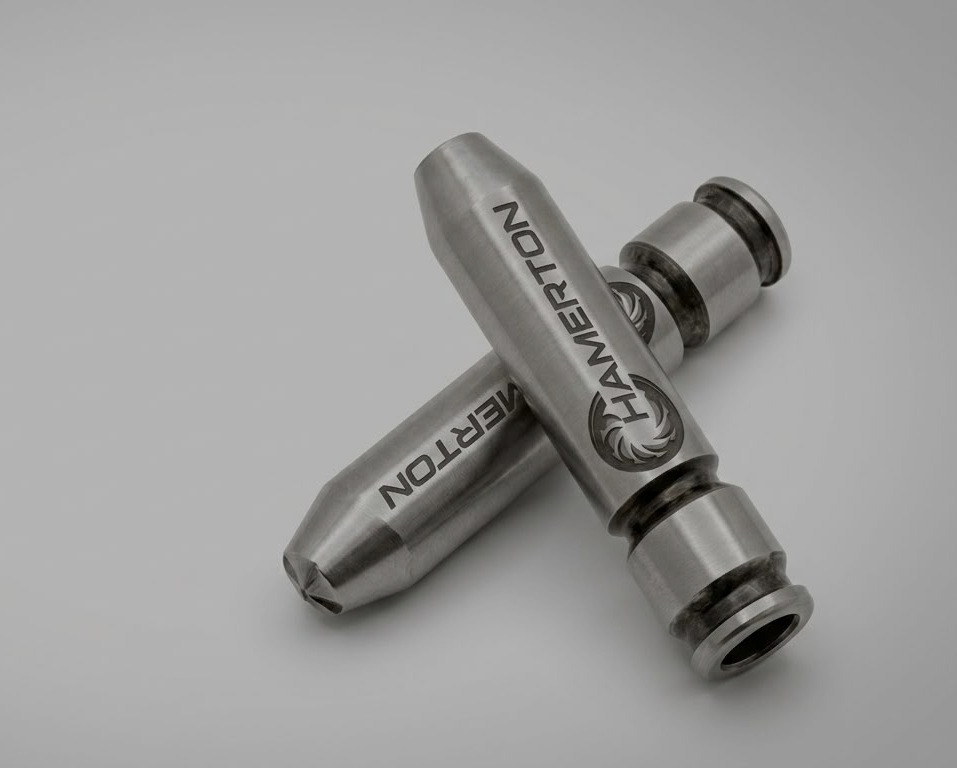
Headspace decides whether a cartridge is supported the way its designer intended. Miss it by a few hundredths of a millimetre and the same rifle goes from accurate and safe, to stiff and hard to open, to genuinely dangerous. A set of gauges answers the question in under a minute, which is why every chambering job and every inspection of a used gun should start with one.
What headspace actually measures
Headspace is the distance from the bolt face to the feature in the chamber that stops the cartridge moving forward. Which feature that is depends on the case:
- Rimless bottleneck (.308 Winchester, .223 Remington, 6.5 Creedmoor): a datum circle of a defined diameter on the shoulder cone.
- Rimmed (.303 British, .38 Special, .45-70 Government): the rim, so headspace is the depth of the rim recess.
- Belted (.300 Winchester Magnum, .375 H&H): the forward face of the belt.
- Rimless straight wall (9×19 Luger, .45 ACP, .380 ACP): the case mouth against a step in the chamber.
A gauge is a hardened, ground steel dummy cut to one exact dimension on that datum. It has no powder, no primer and no tolerance stack of its own, so what the bolt tells you is the chamber, not the ammunition.
Too tight, too loose
Insufficient headspace means the bolt has to crush the case to close. Chambering gets hard, pressure climbs because the case cannot seat properly, and extraction suffers.
Excess headspace is the more dangerous fault. The firing pin drives the case forward, the head is left unsupported against the bolt face, and the brass stretches to fill the gap. That stretch concentrates just ahead of the web as a bright ring: incipient case head separation. Two or three firings later the case parts, and high pressure gas goes into the action, the magazine well and the shooter.
The three gauges
| Gauge | What it represents | Bolt should |
|---|---|---|
| GO | Minimum chamber, the shortest the chamber may be | close |
| NO-GO | Maximum for a new or freshly rebarrelled gun | not close |
| FIELD | Service limit, the point where a used gun is retired | not close |
A correct new chamber closes on GO and stops on NO-GO. A used gun that closes on NO-GO but stops on FIELD is worn, still inside service limits, and worth watching. A gun that closes on FIELD should not be fired.
CIP and SAAMI are not the same numbers. The two standards set different chamber and gauge dimensions for many cartridges, and the difference between them can be larger than the whole GO to NO-GO span. Check a CIP barrel with CIP gauges and a SAAMI barrel with SAAMI gauges. Mixing the two gives a confident, wrong answer, so make sure the standard is marked on the gauges you buy.
How to check, step by step
- Clear the gun. Magazine out, chamber checked visually and by finger, no ammunition anywhere on the bench. Muzzle in a safe direction throughout.
- Strip the bolt. Remove the firing pin assembly, the ejector and, on plunger designs, the extractor. Spring pressure from a live ejector pushes the gauge off the bolt face and is the single most common cause of a false reading.
- Clean everything. Solvent and a dry patch through the chamber, then across the bolt face and the lugs. A carbon ring at the case neck or a chip under a lug reads as a short chamber.
- Use the gauge dry. Wipe off the storage oil. Oil does not compress and will not let the gauge seat.
- Let the bolt do the work. Drop the gauge in and close the bolt under its own weight or with light fingertip pressure. Never use the camming action and never force it. You are feeling for contact, not proving you are stronger than the steel.
- Repeat with each gauge and write the result down before moving to the next barrel.
On an AR-15 pattern rifle, check the barrel extension with a stripped bolt only: extractor and ejector out, no carrier attached. Pushing the bolt in by hand gives a clean feel, while the carrier and the buffer spring hide everything.
Reading the result
- Will not close on GO. The chamber is short, or something is in it. Clean it again and recheck. If it really is short, it needs a few more thousandths with a finish reamer.
- Closes on GO, stops on NO-GO. In specification. This is the target for every new chamber.
- Closes on NO-GO, stops on FIELD. Worn but serviceable. Watch fired brass for a bright ring ahead of the web and retire cases early.
- Closes on FIELD. Out of service. Do not fire it. The fix is setting the shoulder back and rechambering, or a new barrel.
Cutting a chamber to gauge
When you ream a new chamber the gauge is the only stopping signal that matters. Cut, clean, check, repeat, and take less off each pass as the bolt starts to close on GO. Stop the moment the bolt closes on GO with the gauge fully seated, then confirm the bolt still refuses NO-GO. Chasing the last hair of clearance in one pass is how a chamber ends up past NO-GO, with no way back except setting the shoulder back on the barrel. A reamer and gauge set matched to the same standard removes one variable from that job.
Looking after the gauges
Gauges are precision ground and hardened, which also makes them brittle. Keep them lightly oiled and separated in storage, degrease them before use, and never use one as a drift or a punch. A dropped gauge with a burr on the datum is worse than no gauge at all, because it still gives a reading. If you inspect a lot of barrels, compare your gauges against each other now and then: two GO gauges should feel identical.
One minute summary
- Strip the bolt, clean the chamber, use the gauge dry.
- Closes on GO and stops on NO-GO: good.
- Closes on FIELD: stop shooting it.
- Match the gauge standard to the barrel, CIP with CIP and SAAMI with SAAMI.
- Never force the bolt. Force turns a measurement into a guess.
This article is general information for qualified gunsmiths and experienced hobbyists. If a result is out of specification and you are not equipped to correct it, stop and consult a gunsmith.